Automotive Blog
Electric Car vs Petrol Car Running Cost in India 2026
One of the most common questions people ask before buying an EV in India right now is simple — does it actually save money? The short answer is yes, and by a significant margin. But the full answer is more interesting because the savings are not just about fuel. They stack up across multiple areas over time.
This blog breaks down the actual numbers so you can see exactly where the money goes and where it does not.
How Much Does a Petrol Car Actually Cost Per Kilometre?
Take a mid-size petrol car like the Maruti Brezza, Hyundai Creta or Tata Nexon petrol. Real-world mileage for these cars in city driving with AC on is roughly 12 to 15 kmpl. Highway mileage is better, around 16 to 18 kmpl.
Here is what that works out to per kilometre:
City | Petrol Price | City Mileage (13 kmpl) | Cost Per Km |
|---|---|---|---|
Delhi | Rs 94.77 | 13 kmpl | Rs 7.29 |
Jaipur | Rs 103.54 | 13 kmpl | Rs 7.96 |
Mumbai | Rs 107.46 | 13 kmpl | Rs 8.27 |
Hyderabad | Rs 107.50 | 13 kmpl | Rs 8.27 |
For a person driving 1,200 km a month roughly 40 km a day the monthly petrol bill works out to:
Delhi: Rs 8,748
Mumbai: Rs 9,547
Hyderabad: Rs 9,924
These numbers are before you factor in any maintenance costs.
How Much Does an Electric Car Cost Per Kilometre?
EV running cost depends on two things — how efficient the car is and how much electricity costs in your city.
Domestic electricity rates in India currently range between Rs 5.50 per unit in Gujarat to Rs 8 to Rs 9 per unit in Maharashtra, Delhi and Karnataka depending on your consumption slab.
A typical mid-size EV like the Tata Nexon EV, MG Windsor EV or Hyundai Creta Electric consumes roughly 15 to 18 kWh per 100 km in real-world driving. That translates to about 6 to 7 km per unit of electricity.
Here is what home charging works out to per kilometre
Electricity Rate | EV Efficiency | Cost Per Km |
|---|---|---|
Rs 5.50 per unit (Gujarat) | 6.5 km/unit | Rs 0.85 |
Rs 7 per unit (Delhi) | 6.5 km/unit | Rs 1.08 |
Rs 8 per unit (Mumbai/Bangalore) | 6.5 km/unit | Rs 1.23 |
Rs 9 per unit (higher slab) | 6.5 km/unit | Rs 1.38 |
So home-charged EVs cost Rs 1 to Rs 1.40 per km in most Indian cities. That is six to eight times cheaper than petrol.
For the same 1,200 km a month:
Delhi EV: Rs 1,296 per month
Mumbai EV: Rs 1,476 per month
Hyderabad EV: Rs 1,380 per month
Monthly Savings Petrol vs EV
City | Monthly Petrol Cost | Monthly EV Cost | Monthly Saving |
|---|---|---|---|
Delhi | Rs 8,748 | Rs 1,296 | Rs 7,452 |
Mumbai | Rs 9,547 | Rs 1,476 | Rs 8,071 |
Hyderabad | Rs 9,924 | Rs 1,380 | Rs 8,544 |
Over a full year, that works out to
Delhi: Rs 89,424 saved per year
Mumbai: Rs 96,852 saved per year
Hyderabad: Rs 1,02,528 saved per year
Over five years the savings cross Rs 4 to Rs 5 lakh on fuel alone. This is a significant number and it explains why total cost of ownership comparisons often show EVs coming out ahead despite a higher purchase price.
What About Public Charging?
Home charging is the cheapest option by far. But if you charge at public DC fast chargers on a highway or at a mall, the rate is higher.
Public DC fast charging at networks like Tata Power EV, ChargeZone and Statiq currently costs between Rs 18 and Rs 25 per unit in most cities. At that rate, the cost per km goes up to Rs 3 to Rs 4.
That is still cheaper than petrol but the gap narrows. The smart approach most EV owners follow is to do 80 to 90 percent of their charging at home overnight where the cost is lowest, and use public fast charging only when needed on trips.
Full Charge Cost for Popular EVs in India
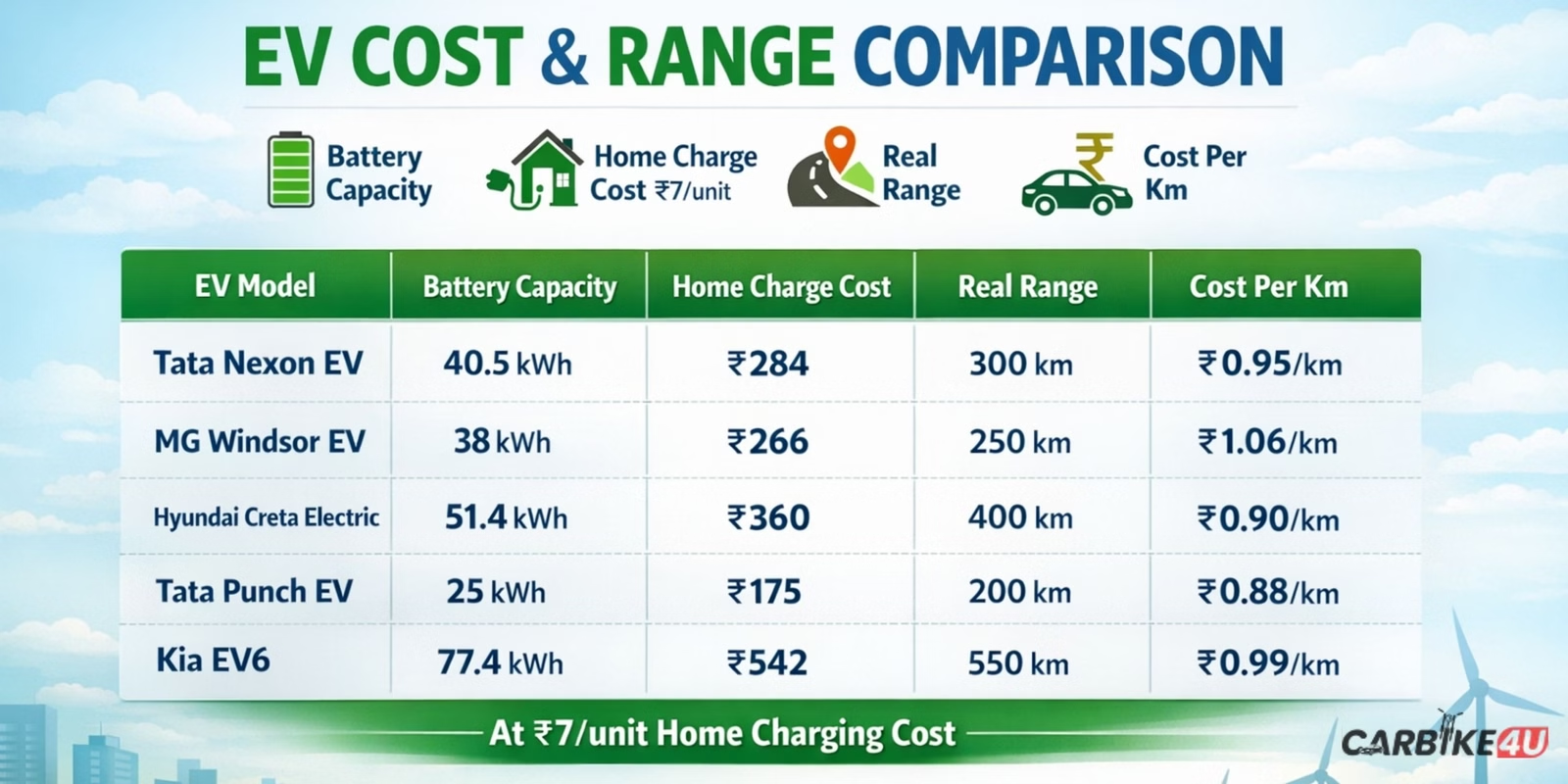
All of these come out under Rs 1.10 per km at home charging rates. Even at Rs 9 per unit the cost stays well below Rs 1.50 per km.
Maintenance Cost Another Area Where EVs Save
Running cost is not just about fuel. Maintenance is a major part of the monthly cost of owning any car.
A petrol car needs an engine oil change every 5,000 to 10,000 km, which costs Rs 2,000 to Rs 5,000 each time. It also has spark plugs, filters, clutch plates, a cooling system, exhaust components and dozens of other serviceable parts that wear over time.
An EV has no engine oil to change, no spark plugs, no clutch, no exhaust and significantly fewer moving parts overall. The main maintenance items are tyres, brake pads which actually last longer on EVs due to regenerative braking, AC filter and battery health checks.
Over 5 years, a petrol car typically costs Rs 60,000 to Rs 1,20,000 in routine maintenance depending on the model. An equivalent EV typically costs Rs 20,000 to Rs 40,000 over the same period.
The Only Area Where Petrol Still Wins
Long highway trips without a charging stop. If you are driving 400 to 500 km in one stretch and there are no fast chargers on your route, a petrol car is more practical. A full tank can take you further and refuelling takes 5 minutes.
This gap is closing fast as charging infrastructure improves. NHAI has been adding chargers on national highways and Tata Power, ChargeZone and other networks have been expanding. But for now, if highway range anxiety is a concern for your driving pattern, it is a real consideration.
For city buyers who drive 30 to 60 km a day, park at home overnight and charge at home, this limitation almost never comes up in daily use.
Real World Summary EV vs Petrol
Factor | Petrol Car | Electric Car |
|---|---|---|
Running cost per km | Rs 7 to Rs 9 | Rs 1 to Rs 1.5 |
Monthly fuel cost (1,200 km) | Rs 8,500 to Rs 10,000 | Rs 1,300 to Rs 1,800 |
Annual fuel saving vs petrol | - | Rs 85,000 to Rs 1,00,000 |
5-year fuel saving | - | Rs 4 to Rs 5 lakh |
Service cost per year | Rs 12,000 to Rs 25,000 | Rs 4,000 to Rs 8,000 |
Highway range | No issue | Depends on charging availability |
Refuel/recharge time | 5 minutes | 25 to 30 min (fast) / Overnight (home) |
Purchase price premium (EV) | - | Rs 2 to Rs 5 lakh higher |
So Is an EV Worth It in 2026?
For someone who drives 30 to 50 km a day in a city, charges at home and keeps the car for at least 4 to 5 years, the numbers make a strong case. The higher purchase price gets recovered through fuel savings within 4 to 5 years in most cases, and the lower maintenance cost adds to the advantage from day one.
For someone who drives 80 to 100 km a day on highways regularly, parks where home charging is not possible or needs the flexibility of a 5-minute refuel, a petrol car still makes more practical sense right now.
The answer depends on your driving pattern. But for most urban buyers in India in 2026, the running cost of an EV is simply too good to ignore.
For city-wise on-road prices of all EVs and petrol cars currently on sale in India, keep checking carbike4u.com.

Written by Team CarBike4U
Editorial & Research Team
CarBike4U's dedicated editorial team researches, reviews, and updates content to bring you the most accurate automotive news, pricing, comparisons, and ownership guidance.